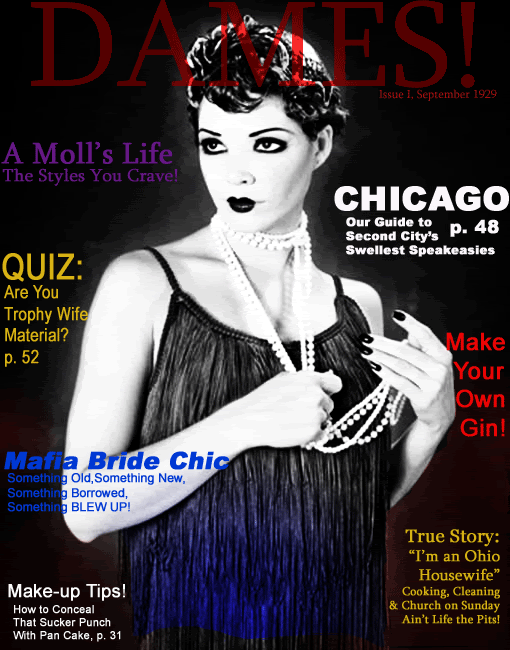
Introducing a brand new magazine: DAMES! The only ladies' journal focusing on the lifestyles of gangster molls, mafia wives, call girls and hoodlums. Our motto is "Gin and Jazz forever! Our economy will never die!" So bob your hair and sneak that flask in your garters, gals...because DAMES! has hit the stands!!
Thursday, June 26, 2008
DAMES!
Introducing a brand new magazine: DAMES! The only ladies' journal focusing on the lifestyles of gangster molls, mafia wives, call girls and hoodlums. Our motto is "Gin and Jazz forever! Our economy will never die!" So bob your hair and sneak that flask in your garters, gals...because DAMES! has hit the stands!!
Saturday, June 21, 2008
The Rotter's Rose, 1.6
Tamsin shook herself awake and tried to blink past the overwhelming sense of bluntness she felt all over. Nothing felt broken. Nothing felt terribly wrong. She thought maybe she had bruised her thigh at most.
She was lucky. She had fallen on a great mass of rubber cables and ropes, and they had broken her fall. Some of them were surging with electricity and others were as dull and lifeless as a corpse.
Tamsin grunted softly to herself as she stood up. She began to notice tiny lights winking from the brass plated walls and the high-pitched song of machinery. No doubt she had fallen to the Difference Room—one of the lowest and most important decks on an airship. It was here that the men worked magic on their gargantuan difference machines. Tamsin had never really understood the equipment, but understood that these machines and the endless strings of numbers they spooled out were responsible for keeping air ships afloat and navigation in order.
Usually there were large cargo holds close to Difference Rooms. They were there to move equipment on and off easily. Tamsin hoped she could find one quickly and maybe pinch a parachute or steampack while she was at it. The sounds of the battle had abated, and that was bad, because it meant she had to get off the ship before Torrance’s triumphant crew found her or the victorious Roberts shot the ship out of the sky.
Adrenaline pushing her on, Tamsin rushed through the hold’s door hoping to find her exit. Instead, she only found further complications.
Five Difference Men were hunched around their equipment. Two were working with screwdrivers trying to pull apart panels and another two were hurriedly disconnecting wires and flicking brass switches in despair. The fifth, whose back was still to Tamsin, was surveying the others.
“Hurry! Hurry!” said one, “Torrance is dead! We’ve got to clean the tapes before the pirates get wind of this!”
Another said, “I still can’t believe Torrance is dead.”
“Well believe it,” said the first, “and hurry…if this falls into the wrong hands…well…Operation Turnstile is booched!”
“Quiet!” snapped the fifth man. “We’ve got company.”
Tamsin shuddered in dread as the difference men slowly turned around and faced her.
“What did she hear?” asked the first in a panic.
A new one questioned, “Who is she? Is she one of them pirates?”
“Look, I don’t know what you’re all doing, and frankly, I don’t care. It sounds like my side of the fight won, and now I just want to get off this ship and meet them…okay?” Tamsin explained in the most diplomatic terms she knew.
One of the younger men laughed. “A girlie pirate…and I thought I’d seen everything!”
“Eh…she’s probably just the Captain’s wench…a little fun on the side.”
“I could use a little on the side, if you know what I mean…”
She cried venomously, “You all better get back. You better let me off this ship, or you’ll have me to answer to!”
One of the men piped up, “Lookie here, fellers…a real shot of sassy-frass.”
Tamsin blinked furiously. The man was belittling her. He was refusing to take her seriously as a warrior—as anything other than a piece of meat to devour.
“Mebbe we be nice to you—if mebbe you find the right type of persuasion…” the leader said with lechery dripping like drool from his mouth.
Tamsin began to slowly hike up her petticoats, revealing her scarlet garters and milky white thighs.
“I gotch your persuasion right here,” she mewed.
The men’s rapture turned to fear as they suddenly realized she had two neat little white leather holsters strapped to both of her thighs. With a flash, her dainty hands had found the coral handled pistols in each one, aimed the barrels at the men and pulled the triggers.
The brains of two of the men now lay splattered across the hull plating—blood and bits of flesh mixed in. A second later and two more men had collapsed. This time she had aimed for their hearts, and her victims had been left with dark circles on their chests. Red was quickly spreading from the wounds’ dark centers, chasing the blue fabric of their shirts. It looked as though the men now wore bullseyes on their chests.
Now, only the leader remained. Tamsin drew her aim left of center and blew off his hand. She smirked as his gun clanged on the iron floor. The man, once gruffly arrogant, was bent over in pain—sobbing like a little boy and clutching the bleeding stump that was once his right hand.
Tamsin returned her guns to their concealed holsters and began to strut forward, chasing the crying man backwards until he was pinned against the wall. She leapt up and grabbed hold of a pipe above her and let her body dangle for a moment. Then, she swung herself backwards and used that inertia to pull her legs up. She climbed her feet furiously up his torso, digging her spurs into his flesh with every step. Finally, she tore her left spur into his shoulder and held her right spur to his throat.
Wednesday, June 18, 2008
The Rotter's Rose, 1.5
...The bullet would have hit Roberts’s chest, if not for the jerking roll his shoulder had just made. Instead it ungraciously grazed his armpit. It was the signal for the temporary peace amid the fray to end. The deck was consumed by a cacophony of shots, grunts and screams.
Roberts fell upon his right knee as he felt the blood pool out from his wound. Defying his pain, he tried to find the quartermaster with his gun, but Taylor was faster. Taylor swooped his machete across the quartermaster’s face and then fired a blunt round into his chest with the other hand.
Torrance’s face had hardened into a steel gargoyle’s mask. His saber was raised above his head and he closed in on the kneeling Roberts. With a swift swing, Torrance had disarmed Roberts of his pistol. Before he could decapitate Roberts with a backswing, however, Roberts had somersaulted out of Torrance’s way across the wooden deck floor.
As Roberts tumbled across the deck, he managed to pick up a pistol dropped by another man earlier in the fight. He turned over onto his back and held the gun above himself, pointing it madly at Torrance, who was swaggering atop him wielding that vicious blade. He squeezed the trigger and recoiled. The back-fire on the gun sent a shock wave through his arms and into his throbbing wound. But the pain stinging from his armpit was nothing compared to the look of blank horror on Torrance’s face. His eyes bulged out in recognition of death and he slumped to his knees and then backwards and then into nothingness.
“Well that was anti-climatic,” Roberts grumbled to no one but himself. He didn’t know whether to feel a surge of pride at killing such a famed hero or to feel offended that such a legend gave so poor a fight.
He glanced around the deck and saw that in less than a minute, his men had indeed overtaken the ship. The bodies of Torrance’s men laid strewn across the deck like seaweed upon a beach.
Taylor held out his hand to help his captain up. “Sir?”
“Gonna need the other hand, Taylor,” he replied, motioning to his right armpit. His white shirt was now drenched in blood seeping out from the center of the wound.
It took Roberts a moment to steady himself on his own two feet. Taylor and the rest of the men looked on at him with a bit of worry, which Roberts immediately swatted off. “I’m fine…fine.”
To show them, he arched his back and stood up tall. He centered his balance and then began to stolidly walk across the deck with the same proud strut he always used. Once the men ceased their concern, he asked Taylor, “Where’s Hanson?”
“He took three men down below to see if they could rendezvous with Tamsin and the Southerner.” Taylor never referred to Jackson Wilkes by name. He was still too sore that the crew had elected the new Southern steampacker to the position of quartermaster—a position that had previously been his.
“And we did!” Hanson’s voice whooped from below. He and his party of men were heaving a large, metal chest with pride.
The youngest of his men cried, “And we got us here the loot, too!”
“Let’s move out. Fast as you can, boys! Fast as you can!” Roberts said. A steam rat was coming to and Roberts drolly shot him dead.
Jackson came lumbering up behind Hanson’s boys. He rushed past them and grabbed at Roberts’s left elbow. “They got Tamsin. The Chinese Box had trapdoors and she fell.”
“Oh yeah?”
“Yeah, at least twelve feet. I think she’s knocked out. I called and called for her, but—”
Roberts clucked. “And your point is?”
“We can’t leave her.”
He chuckled at the new kid’s naivety. “If Tamsin needs help to survive a short little fall, then we don’t need Tamsin.”
“What about ‘No man left behind’?”
“Never took to that mode of thought. I prefer ‘No gold left behind’.”
“We can’t go! We can’t go!” Jackson cried.
Roberts slapped him cold across the face. “We’re going.”
***
Saturday, June 14, 2008
The Rotter's Rose, 1.4
***
Torrance’s young boatswain fell to the deck with a dull thud of death. Smoke danced from the bullet hole in his chest. Roberts didn’t even look at the boy. He merely cocked back his pistol and prepared to fire at the grizzled quartermaster charging his way.
“Stop!”
The voice came out of nowhere. It was clear, confident and calmly poised for action.
Torrance’s sword was suddenly holding the quartermaster back. All of Torrance’s men had paused at their captain’s command. They were conflicted, but loyal to his words. Roberts’s own crew had also stopped, but out of sheer confusion. They all looked to Roberts, who was still looking at his prey.
“But…sir!” the old sea dog clamored. “This pirate has gone and killed poor Sully. We must have his blood for that!”
Torrance quietly replied, “And that we will.”
Captain Torrance walked past his men to face Roberts. “I have to admit, I had often heard tales of The Rotter’s Rose. Even as a young man in His Majesty’s Aero Force, I had heard warnings about how we do not engage The Rotter’s Rose. We do not fight Captain Hogarth and his Rotten Rogues. It would have been easy, in those days, you know, for the Aero Force to pick off the ship. Hogarth was not a great tactician, nor was he considered a great leader of men. But, of course, you know that, don’t you? You must have been there when Vicious Stiehl killed him. You must have been part of the mutiny. You probably even voted for it.”
Roberts’s face was as blank as a slate. Not one of the Rotten Rogues could tell if Torrance’s retelling of the Mutiny of ’54 was getting under their Captain’s skin. He made no sign that he was even aware that Torrance was speaking. He only stared straight ahead with his glacier blue eyes, blinking occasionally because of the smoke.
“Hogarth had his secrets…” Torrance teased.
Roberts responded, “I’m sure.”
“But all in all, he was a good man, as I understood it.”
Torrance had somehow corralled himself and Roberts into the center of a ring of men. Roberts felt uneasy, as though he had been signed up for a boxing match he hadn’t been able to train for. Never taking his pistol’s aim off of Torrance, he quickly glanced about the circle of men. The Rotten Rogues out numbered Torrance’s men at least two to one. He saw them all staring silently. Their faces were caked with blood, oil and sweat. Taylor, one of his best men, was standing closer to the enemy’s side—a mere step away from both the quartermaster and the captain. It could be over in a matter of one second. Roberts couldn’t understand why his men didn’t act, didn’t erupt, didn’t end this wicked fight. Yet somewhere in the pit of his stomach, he did know.
He knew that they were frozen in quiet anticipation for the same reason that he could not yet shoot Torrance. The captain possessed a rare dignity. His bearing and posture and words all came together to create something that was all too rare in these war weary days: quite simply, he was a great man. He was a man who demanded honor from his enemies. Roberts’s stomach twisted in dread as he realized what Torrance was about to ask him.
“Captain Roberts,” Torrance declared, “I have heard great stories of your fearsome deeds. I understand that you were a prodigy of pain and that you have grown into a master of murder. Still, I have heard more of you. I have heard that unlike Vicious Stiehl you are a captain who takes the safety of his crew very seriously. I believe we share this quality, and so I ask you, captain to captain, man to man, that we settle this battle ourselves.”
“You’re proposing that we fight a duel and that the winner claims victory over the battle?”
Torrance assented. “Precisely. You’re telling me that you wouldn’t relish the challenge, Roberts? Matching your blade with mine?”
Roberts exhaled and chose his words very carefully as he replied. “You speak as though we were equals, and we are not. You speak as though I were like you, a man who betrayed the good captain who sheltered me in my youth for my own taste of glory. You speak as though we could possibly share respect for one another. You speak as though I were a man of my word and that you were a man of your own. You speak as though you know everything about me, and yet you don’t even know my real name.”
Torrance touched the tip of his sword with his left index finger. He looked at the blood bubbling up from the tiny pinprick with disappointment. “Well, that is a shame…” he muttered. “Here I thought we might come to an understanding. I thought perhaps we could save ourselves a lot of trouble and save many lives.”
“Unfortunately, that isn’t the case.”
Thursday, June 12, 2008
The Rotter's Rose, 1.3
A nervous looking lad of about seventeen immediately jumped up from the middle of the vault. He placed his hands above his head and cried, “Don’t shoot! I ain’t got any weapon!”
Tamsin stepped out of the way to let Jackson finish this one. He surprised her by shooting the boy in the leg.
“What was that for?” she demanded. “You had a clear shot!”
Jackson had already walked past her and was working on picking the lock of one of the trunks in the center of the room.
The lad began to wail in pain. “Fucking Jesus Christ Mary oh my leg it agh shit God Almighty…”
He sounded like a toddler in the midst of a temper tantrum.
“Tamsin, honey, come over here,” he entreated. “I need you to help me open this chest.”
She sighed and complied. For the moment, she was distracted from the wailing boy by the hunger of her imagination. She was about to explode at the thought of what treasures were hidden inside. Chinese vaults were usually only owned by the richest of merchants and pirates. Would it be gold, cash, glittering diamonds from the coast of Africa or something more magnificent than even she, in all her powers of avarice, could imagine?
They swung the trunk open and discovered a neat cache of tiny white bits of paper bound together in small lumps by twine. Tamsin flipped through the sheets of paper in disappointment. “Why this isn’t gold!”
“They’re bonds,” Jackson said in quiet appreciation.
Tamsin gave him a questioning look.
Jackson answered, “Tamsin, this is as good as gold. Each piece of paper stands for a bar of gold in the British Treasury.”
“Yeah, but ‘stands for’ doesn’t necessarily mean ‘equal’. Unless I’ve got a gold bar in my hand, I ain’t got no gold bar at all.”
Shouts came from outside the cargo hold. Jackson’s shotgun somersaulted through the air as he snapped it back in their enemies’ direction. Tamsin found herself fluttering madly across the grated floor. If only she hadn’t left her flamethrower outside!
Of course! She thought to herself. I still have my…
But she didn’t complete the thought. She couldn’t have. Not while the floor beneath her had disappeared. Not while she fell swiftly through the air and crashed into a heap on the cold metal plating fifteen feet below.
Up in the vault, Jackson turned around to find Tamsin gone. The grated floor upon which she had stood was also gone. He looked at the boy who had been in the vault that whole time. He was no longer screaming in pain. He had dragged himself to a series of levers by the wall. One of them was thrown down and his left hand was poised to pull another one. He was laughing now. It was a cruel dark laugh of fate.
“BAM!” Jackson’s shotgun thundered and smoked.
The boy was finally dead.
Jackson pivoted back to face the oncoming group of enemies alone and was relieved to see it was Hanson and about three of the other Rotten Rogues smiling in the doorway.
Tuesday, June 10, 2008
The Rotter's Rose, 1.2
Tamsin was trying her best not to shiver, lest her trembling threw Jackson’s equilibrium off. She thought ruefully that Roberts had been right; she should have worn the tight denim trousers of a steampacker or a leather coat. However, as soon as Roberts told her that she would be flying with Jackson through the clouds, she had been less worried about warmth and more concerned about looking pretty. She had been defiantly set on wearing her layers of knee length petticoats. She carefully selected an embroidered vest to wear over her muslin blouse and spent hours fretting over her rouge and curls. Roberts had called her a “besotted fool”, but it didn’t matter because Jackson had said she looked pretty.
She would have still looked pretty if she hadn’t been soaked through by the clouds. Now, she looked no better than a drowned rat in goggles, dangling aimlessly from Jackson’s torso. She was ashamed by the thought of what she must look like to him now.
Jackson, however, was a steampacker, and as such was too busy reading the dials and valves on his wrists to worry about how ugly the cold girl trembling at his chest looked. His mind was now surging with temperatures and pressure percentages, the force of gravity and the pull of the wind. So many physics calculations were flying through his mind and he was quick enough to figure them all out within a second. If he was sloppy, his jittering, roaring backpack of steam could explode due to pressure or run out of helium, leaving them to death.
Jackson was doing his job, and Tamsin was bored out of her mind, waiting for their part of the battle to begin.
“Is it time yet?” Tamsin called impatiently. “I hear shots in the distance.”
He turned his attention from the pressure valves on his right sleeve to the brass watch attached to his left.
“Twenty-nine after six. Right on time.”
Tamsin almost squirmed in impatience. “Are we gonna go?”
“You still got my gun?”
“And the flamethrower and blowtorch,” Tamsin answered affirmatively. They were all tied and clipped on to the harness she was wearing, much like she was attached to his harness. She grimaced for a moment at the undue weight they placed on her shoulders. It never occurred to her that Jackson felt their weight, too, as well as hers.
“Alright, here we go,” Jackson declared.
He suddenly crouched his body forward, displacing Tamsin’s position of comfort in the process. The engines suddenly stopped their steady whirling and began to whistle furiously as Jackson upped their speed. They were no longer hovering in mid-air, but zooming quickly through space.
Jackson meandered through the sky. He randomly darted east and then west, cut the power to drop through the air and then fired his pack again to lift off into the sky. To a casual observer he was flying like a madman, but Tamsin understood what he was doing. Stealth was of the utmost importance in their little ploy and Jackson was being careful to always be flying in cloud cover. Roberts had made it clear that it was essential that she and Jackson remained unseen. While The Rotter’s Rose kept their prey occupied on their port side, she and Jackson would infiltrate the ship on the starboard side.
Jackson paused in the middle of a cumulus cloud and quieted the engines. Tamsin could hear the cries of battle much clearer now. She could make out the pops of pistols being shot, the rat-tat-tat of the machine guns and the cries and curses of the men at war. She sighed and smiled, feeding off of the adrenaline now surging through her veins.
“You ready?” Jackson asked.
She nodded and said, “Let’s start a riot.”
He chuckled. “Alrighty.”
With that Jackson led them cleanly through the cloud and into the maelstrom of battle. Tamsin immediately looked to their flanks, their heavens and their belows for any sign of an another steampacker who might try to snipe them down.
“All clear!” she shouted back to Jackson.
Roberts’s plan had worked. Most of the small airship’s attentions were placed on her port side. The men were scrambling to fend off the machine guns singing from The Rotter’s Rose and the boarding party that would attack from that side. The starboard side, however, was almost entirely empty. Tamsin and Jackson were to sneak in on this side.
As they swooped down towards the starboard deck, a couple of steam rats hurried to repel them. Tamsin’s stomach churned slightly as she saw the men pull out pistols and point them in her direction. She unconsciously aimed her own weapon—her flamethrower—at them and noticed a trilling laugh trickle from her throat as she pulled back the trigger. She heard their screams as the flow of fire whirled across their skin. A strange focus consumed her mind as she realized that the fight had begun. She was very much alive and she was going to stay that way.
She heard the steampack’s engines jolt down before she felt them stop. Her skin sparked like firecrackers as she felt Jackson’s hands move around her to unlatch her from his harness. She hardly had anytime to process this tiny excitement though, as more steam rats with more guns rushed from the hold.
Jackson didn’t have time to unlatch his shot gun from Tamsin’s harness. His arms wrapped around her body from behind to aim the gun. Jackson snapped back three shots and swiftly brought down three men. Tamsin, in turn, let loose her flamethrower once more to repel the remaining men charging them.
“Let’s move,” Jackson said tersely as he unclipped his gun from Tamsin.
They made their way carefully below deck, clinging to the dark walls in an effort not to be seen. No one was there, though. Most of the crew was either on the port side, dealing with flames and gunfire, or shouting from the difference and engine rooms below. Jackson led them down another deck to where the cargo hold would be.
He had placed one foot on the stairs when a guard shouted, “Oy, Stan! ‘Ere we go!”
Tamsin grinned as Jackson leaped down the rest of the stairs in a single, fluid bound. She heard his shot gun fire, a grunt, and then another round went off. By the time she had made it down the stairs, both guards were dead on the ground.
“Wow, you are good,” she admired.
He said nothing. He was kneeling by the bodies searching for keys.
Tamsin surveyed the cargo hold door. “It’s no use. There’s no lock on this side. It must be one of those Chinese box designs that opens from the inside.”
Jackson looked quickly at the steel door and saw that indeed, there was no handle or lock, but only hinges. He nodded to Tamsin, “Cut it.”
She dropped her heavy flamethrower on the floor and quickly unlatched the blowtorch from her harness. Before she fired it up, she tugged at her goggles to be sure they were tightly fastened. Jackson covered her as she burned through the inch of steel. She heard shouts and guns going off and the quick, cocking action of Jackson’s gun being consistently reloaded.
Friday, May 16, 2008
The Rotter's Rose, 1.1
Fire billowed across the sky and adhered itself to the sails of the small airship. Shouts of distress pierced through the clouds. The steam rats were in a frenzy trying to put out the flames. If the sails burned, then they were done for. The ship would plummet to the earth as soundly as a stone. The officers, however, were possessed with a different type of tension. Frenetically, they paced the deck shouting commands and preparing for battle.
Across the chasm of clouds, Captain Arthur Asher Roberts observed the havoc securely from the starboard deck of his ship, The Rotter’s Rose. He regarded the scene with a discerning gaze, peering through his spyglass and cutting through the chaos of the moment with the type of wisdom that only came from experience.
He was quietly taking note of the number of men on the other ship ready to put up a fight. Most of the steam rats seemed occupied with either fire fighting or fear. He counted only about seven competent men on the deck. An older sky pirate—who must have been their Quartermaster—was pacing the deck and trying to guide the younger men into action. He looked stocky, confident and grizzled, and so Roberts surmised that the old dog would probably be tough to kill. The Boatswain, a spiny fellow sweating about the ropes, looked more frazzled and underfed. He was young and had likely only seen battle from afar. He would be easy to take out. There were two brawling types—likely mercenaries. The smaller, goateed one had scrambled to one of the machine guns and the larger bald one stood, grasping a mast, howling to the wind as he fired his rifle to the heavens. They could pose a challenge, Roberts thought as he smiled wryly. There were two younger men—athletic, but not burly—flanking another older man. Their pistols and gazes were set directly in contempt to The Rotter’s Rose and in loyalty to the man between them: Captain James Torrance.
“Ah ha,” Roberts said as he recognized his enemy in the spyglass. “Torrance, you old coward. Let’s see how much of that British treasury you’ve got in your holds this time.”
Torrance had once been the pride of Her Majesty’s Aero Force, and had received numerous medals and accolades for his bravery in the Great London Blitzes of the 1940’s and 1950’s. But as recent years rolled around, Torrance discovered that he had aged into a spiteful and embittered man. He was tired of risking his life in the skies when the nobleman below sat miserly upon heaps of treasury funds. Greed and disillusionment had overtaken Torrance and in a stunning show of betrayal, he had killed a treasury officer and stolen his portmanteau, and with it records of every secret cache of British wealth in the entire world.
Roberts expected such duplicity from that breed of sky dog, who, like him, had been lost by his homeland at a young age. It was all well and good to live only for yourself, but if you had spent as much of your life as Torrance had in the service of something greater, you had best never do it wrong. He saw Torrance as a traitor, and as such, decided that he deserved neither the mercy nor respect he may have shown any other pirate captain.
Roberts was going to relish destroying this famed fighter of the skies.
“Captain Roberts,” a woman’s voice chirped from about thirty feet above him. He didn’t need to look up to know it was Winifred “Fred” Bailey, his best lookout, addressing him.
“Aye, Fred? What’s troubling you?”
She answered back, her Australian accent quivering with anxiety, “Well, you just said it was Torrance. If that’s true, then those roughnecks on board are likely to be former British soldiers.”
He glanced up. “And your point?”
“They may not be as spirited as Confederates or as organized as Nazis, but they’ll be just as hard to kill. Are you sure it’s worth the loss of men? They may not even have any gold.”
“As long as Wilkes and Tamsin do what’s planned, I have no doubt that we have the edge on them.”
“But they could have more soldiers hidden below deck, and can you really expect Hanson to be prepared for that? Not to mention what Torrance likely has to offer?”
Roberts considered Fred’s words. She had a tendency to be a worry worm, but her arguments were usually sound. He though about his options and then grinned up at her as he made his decision. “Then it looks like I’ll be leading the boarding party. I have a mind to learn how Torrance lives up to his reputation.”
Fred groaned as she watched her Captain saunter to where the boarding party was preparing their ranks. To the casual observer, he looked too pretty, too preened, too polished to be a ruthless cutthroat. His ebony locks were always smoothed back and glistened with pomade. His pale face was hairless save for his eyebrows and carefully tended sideburns. He was a handsome man, at least that’s what Fred had heard other women say about him, but she had never noticed. Something about his cold blue eyes or broken nose had left her feeling vacant. He had no piercings, no peg leg, and no parrot chirping one-liners on his shoulder. He wore only the best cut suits and his waistcoats were made from the most colorful Chinese silks. In fact, he was never seen without a waistcoat. Even when he dashed off his jacket and rolled up his sleeves to fight, his waistcoat stayed on. Unbuttoned, but still on. Despite these trappings of gentility, he was a pirate through and through. He was a natural leader of men, a determined con artist, lucky gambler, ace shot and former boxing champion of the greater Brixton rings. His one weakness was perhaps his pride, and his sheer determination in the face of impossible odds. Fred realized in retrospect that by mentioning Torrance’s strength as fighter, she had only baited the beast within her Captain.
Wednesday, December 5, 2007
How Not To Be Famous
From the National Institute for Stasis and Subsistence:
With the onslaught of the holiday season comes an alarming new danger. Traditionally, this time of year has been associated with the influenza virus and the common cold. Immune systems, weakened by pathogenic invasions from the open sores that cover many of our swollen, obese bodies, so often immobilized by the intake of an estimated 13 billion metric tons of unloved fruitcake, cannot cope with further threats. The t-cells and b-cells that comprise the fearless army of our natural bodily defenses choke and die on bloodstreams poisoned by nightmarish pharmacological cocktails. In the midst of this chaos rises a new and deadly threat: fame.
The common fame virus spreads most easily among those living in large, metropolitan regions such as
Studies have shown a marked increase in common fame. Researchers believe this may be attributed to several factors, including the rise of the internet, reality television, and an emaciated news media, bloated by corporate business interests and vitriolic conflict-mongering. These studies note a curious paradox. The amount of total fame has increased only gradually, while a larger number of people share a smaller portion of fame over an increasingly fractured cultural landscape. Surprisingly, the consequences of fame have become more severe.
Some of the symptoms of fame are already well known. These include: substance abuse, car crashes involving substance abuse, vanity, eating disorders, vagina-flashing, and obscene amounts of money disproportionate to an individual’s value in society. To combat this disease, be aware of these symptoms. If you exhibit any, and fall into the right demographic range, we recommend an immediate enrollment into a certified public accountancy program. No public accountant has ever become famous. Additionally you should:
- Stop washing your hands. Fame does not afflict the unclean, so long as you do not dedicate your life to selfless acts of charity.
- Avoid casting calls/couches for reality television programs
- Not attempt random acts of accidental heroism and try to sell the movie rights
- Become morbidly obese. But not TOO obese, because then you might experience a fame-related pathogen called Infamy.
- Suppress your talents and dreams
- Not exhibit signs of charm, charisma, or photogenicism.
- Eat raw garlic hourly
- Aspire to conform to the mundane norms of your established social structure
- Not betray original concepts or ideas that could “set you apart.”
- Attempt to live vicariously through the celebrities you admire who set out to achieve everything that you have wasted your life vainly wishing you were good enough to achieve.
- Only abuse mundane drugs
- Enroll in “prehab”
With these guidelines in mind, we hope you have a safe and anonymous holiday season.
Monday, March 19, 2007
The Adventures of Augustina Ruiz, part un.
Augustina had never found a boy particularly attractive before. They were sweaty and vulgar and liked to dangle mice in front of the school's pet boa constrictor, Abbie. None of those things tend to be sexually attractive to a sexually inactive fourteen year-old girl like Augustina.
However, when Rusty Hanson smiled at her from across the mess hall that dreary February morning in 1999, Augustina Ruiz felt something coagulate inside her stomach and explode somewhere a little lower than her stomach. Her knees felt tingly, her forehead began to sweat and before she knew it, she was smiling back at him.
“Did you get your hands on some Prozac this morning?” her best friend Peyton nudged.
“Huh?” Augustina replied. She blinked across the table at Peyton, who was glum and sarcastic as usual.
Peyton added, “You’re smiling…like you’re happy or something.”
“Oh…” Augustina’s mouth twisted itself into a coy grin. “No, St. John’s Wort.”
Peyton nodded. “Cool. Natural mood enhancers are so much cooler than the crap the fascist pharmaceutical companies manufacture.”
“Tell me about it.”
The girls grinned at each other, their eyes sharing a secret celebration of the absurd.
Augustina arched herself over the table in an effort to read whatever great work of literature Peyton was currently writing. It had been preordained that Peyton McLeod would one day be a great author, and if the rest of the world never recognized her work, then at least Augustina Ruiz would be her greatest fan. “So whatcha working on now?”
“Oh, I’m just finishing up a chapter of Newton’s Law,” Peyton replied. Newton’s Law was an ongoing serial about the exploits of a top-secret group of British gangsters and assassins. Though the head of the organization was a nicotine fueled Frenchman, Peyton’s hero was a witty young Englishman named William Newton, who went by the unlikely nickname of “Newt”. Though the series was steeped in violent escapades, the main drama (and comedy) came from Newt’s relationship with his brothers and his futile goal to break free of a life of crime.
It was also a work in progress.
“How close are you to finishing this chapter?” Augustina asked. She had been dying to find out what happened next in Peyton’s twisted literary world.
Peyton paused and flipped through her journal. “Uh…depends on whether or not Denton keeps the lights on during the movie today. I might be able to finish it during class. If not, probably by tonight or tomorrow morning at the latest.”
“Well keep me posted.”
“You know I always do.”
As Peyton went back to her writing, Augustina decided to scan the crowd for Rusty. Breakfast was a chaotic time at the Norman Vincent Peale School for the Positive Minded. Students were pretty much left to come and go as they pleased, eat what they could scrounge and talk as loud as they could—so long as they all reported to their first class on time. In many ways, Peale was an incredibly liberal school. The teachers invested less time in raising test scores than in attempting to raise the moral latitude of the student body. But Peale was still a boarding school, and a social hierarchy existed, as did a rigid set of rules. The rules at Peale were atypical, though. Students could dress in whatever attire they chose and speak whenever they wanted to in class. What they were not allowed to do was to be “negative-minded”. After all, the school had been established in honor of Norman Vincent Peale’s philosophies. Hard work and an optimistic outlook were valued over raw intelligence. So, naturally, the vastly intelligent Peyton and all of her sarcastic portents of doom were dismissed in favor of the sunny, yet vacant outlook of some other students.
The mess hall was divided into five rows of long, pinewood tables, but it was politically divided into territories based on coolness. The greater you were on the social hierarchy, the further away you sat from the gusts of chill winds that blew from the great glass doors that opened onto the deserted pavilion. The jocks, rich kids and “Papillons” (Peale code for “social butterflies and their male courtiers”) all sat around the two long tables furthest from the cold and closest to the hot tray table. Peyton and Augustina only had one table separating them from the pavilion, and that table was populated by squirmy kids under the age of ten. They didn’t really mind not being popular. They thought popularity was a reaction of a puerile mob. They didn’t even mind having to sit between the AV Club and the Chess Team, whose members smelled like tartar or armpits. However, Augustina resented the feeling of cold wind blasting her back during the long Ohio winter, and on this morning, when Rusty Hanson had just smiled at her, she was forced to consider the inequity of her life. Why couldn’t she be a Papillon and flirt and giggle with the boys like Rusty? She had the money they had, and the looks. She only lacked the inane sense of insensitivity that each of those girls possessed. Well, there was that, and Peyton. For as much as Peyton could be morose or sarcastic, she could also be equally as loyal and understanding. You don’t quit friends like that.
Just as Augustina was telling herself that she didn’t need the affection of a flippant boy to make her feel happy, her eyes met his from across the room. He smiled again, and almost seemed to blush when he saw her smiling back. Then, as soon as it had happened, he turned away and joined a group of Papillons in conversation.
Augustina couldn’t help it. The idea of Rusty Hanson simply made her smile.
“What are you smiling at, Teena?” Peyton asked. She had begun to crane her neck around to try to see what or whom Augustina was so pleased by.
“Peyton! Peyton! Please stop!” She grabbed her friend. “I’m sorry. Just promise not to tell anyone but…”
“Yeah?” Peyton leaned across the table in confidence.
Augustina swallowed, and then whispered, “Rusty Hanson smiled at me.”
Peyton narrowed her eyes. “Are you sure he hadn’t just told a joke about you?”
“No! Well, I don’t think so. It didn’t seem that way to me.”
Peyton shrugged. “Be careful.”
“What’s that supposed to mean?”
“Don’t get pregnant?” Peyton shrugged again.
Teena yelped. “Peyton! What the heck is that supposed to mean? He smiled at me. That’s it.”
“Well, that’s how it always begins…”
“Who told you that?” she asked.
Peyton was trying to avoid eye contact now. “My mom.”
“Your mom’s Irish Catholic.”
“Yeah, and she said my grandfather used to get my grandmother pregnant just by shaking his pants at her.”
“What?”
“It’s true.” Peyton then nodded in complete faith.
Augustina shook her head. She said, “That’s crazy.”
“Well, it makes more sense that saying robots harvest babies for their energy.”
“I had just seen the Matrix!” Augustina exclaimed in fierce protestation.
Peyton returned her focus to her notebook, leaving Augustina feeling awkward and embarrassed. She had nothing better to do than tap her fingertips on the table and hope Peyton was wrong about the miracles of conception. Surely Peyton was joking, or perhaps she was jealous…
“Peyton…”
She was still scrawling sentences across the page. “Uh-huh?”
Augustina didn’t know how to say what she wanted to ask, so she struggled to express herself. “If you…I mean, what’s wrong with wanting…What do you think of Rusty Hanson?”
Peyton quickly turned to give the boy a glance and then looked at Augustina. “His hair fits his name.”
“I mean, do you think he’s cute?” Augustina asked.
“Like a puppy?”
“Like a boy.”
Peyton grimaced. “No. I already told you, I don’t like boys.”
It was true. Peyton often said she didn’t think she was heterosexual. She wasn’t homosexual, either. Peyton thought of herself as a graphosexual. She could only be attracted to comic book characters and literary representations of men. Flesh and blood seemed to let her down.
As Augustina’s friend, Peyton could sense that this wasn’t what she wanted to hear. So she said, “Though he is kind of cute like a puppy.”
“Really?” Augustina was surprised.
“Yeah,” said Peyton, “His hair is fluffy and I suppose it would be fun to pet.”
Augustina said nothing, but she did look at Rusty with a more discerning eye.
Peyton added, “And…I suppose if he was older, Cajun, had red eyes, wore a trench coat and was two dimensional, he might look like Gambit. And then I could see the attraction.”
“Oh.” Augustina felt better. She said, “Okay.”
Then the bell rang and it was time for the first class of the day, and that was the day that everything at the Norman Vincent Peale School for the Positive-Minded would change forever.
Sunday, February 11, 2007
The Burning Desk
“Jimmy’s Detective Agency. This is Johnny.”
“Ohthankgod.”
Her voice jabbed at my ear, like a cloying violet blooming in a stone quarry. Or maybe a minefield. I gripped the telephone receiver tight, like I was strangling someone, as I pulled my chair closer to my office desk. I knew that voice. At first I though I had heard it in a car commercial. Then I realized it was my cousin Sue – the one I made out with at the family picnic, the last summer before the war
“Johnny,” she mewed.
“Sugar,” I said.
“I need your help. It’s urgent. Pick me up at this address-”
“Hold on, pumpkin,” I barked, recognizing the voice at last. She was a sweet, troubled kid, the kind of girl who sees the world as shades of innocent sepia. I had a bad feeling in my gut. It was my peptic ulcer hemorrhaging again, and I cursed the world for not making mucous membranes like they used to. “Let me grab something to write down the address with.”
“Hurry.”
“I don’t want to forget, cupcake,” I told her. “I’d regret it for a year or two.”
My hand swiped across the desk, brushing aside empty gin bottles and scratch-off stubs. I needed a pencil bad. A number 2. I could even have tolerated a softer lead, just for that one night, for that one phone call. I woulda grabbed a soft-leaded sissy-stick and scraped it across a scrap of dog-eared 8 ½ by 11 like a man. A pale, sensitive, art-student man, but still a man.
“Johnny, I hear footsteps.” Sue’s voice again. No pencil in sight. No pencil in the whole goddamn office. No time to run out and get one.
“Sit tight, angel face, I’m almost ready.” A lie. Obviously. She tasted it on my breath, straight through the twisted phone line, that’s how much I reeked of lie. I’m good at it – that’s the problem. My living is lying to cops, or to faded-flower spouses who hire me to catch cheating lovers. I lie to make people happier. I lie because they want me to, and because it makes me feel less hollow inside. But this girl, poor Sue, smelled my lie, and knew I was pathetic. I had maybe fifty bucks to my name, with an office on the wrong side of the tracks and a dubious reputation. She called me to save her life, and brave, strong Johnny didn’t even have a pencil to write down her address…
A pencil. All I needed was a pencil. Or even a pen, or a piece of chalk, a diarrheic child’s crayon, or one of those flaky grease pencils from Telegraph Supply. Everyone has a pencil. The crackwhores and the tramps in the roper yards have pencils. My mother has a pencil. And she’s dead.
A bottle of scotch sulked behind a carton of lo mein. A loose woman had dropped it off this morning in exchange for some services rendered. I snatched it up, checking to see if it was any good. No. It was kerosene-cheap, with a similar pine-pitch taste. Flammable.
I poured some into the bottle-green ashtray, and sloshed it around. The scotch soaked up the rancid ash, swirling and gathering darkness and color. I tried dipping my finger into the stuff, and writing on the back of a tax return, partially completed. No luck, and time was running out. I needed to write down her address fast.
“They’re at the door, Johnny”
“Is it still locked, muffin?”
“Yes.”
“Pretend you aren’t home.” I didn’t have time for her caterwauling. I yanked my pistol out from my shoulder strap and cocked the gun religiously. Aimed at the ashtray. Prayed to a false idol. Pulled the trig.
Pow.
The ashtray exploded into bottle-green brimstone, and the heat from the .45 ignited the spilled scotch on my old oak desk. Quickly, I thrust the partially completed tax return into the flame, thinking I could make a piece of charcoal like some mangy collier.
“What was the address again?” I shouted into the black plastic phone, now slippery with sweat. The flames licked dangerously close to the rubber chord. She muttered some words that sounded like a street name. Maybe she shouted. I scrubbed the blackened wad of tax return on the surface of the desk, trying to scrawl the address into the oak, which was beginning to ignite, the shellac peeling back with the dancing orange.
“Oh god. They’re inside.”
“Get down, buttercup!”
“Oh my god!” screamed the woman, and I heard a gunshot. And another. The shots rang with scratchy echoes as they bounced through the telephone wires.
I had to take drastic measures to save her. It was my duty. With a jagged piece of ashtray glass I sliced open the blue vein in my wrist. The blood spurted out, hitting my eye. I dabbed my finger in it, and smeared the address on the wall behind me. The blood dripped on the wainscoting, but remained legible. Then my eyes began to tingle, and I coughed from the acrid smoke, tinged with scotch and cigarette butts and marine shellac from the surface of my bloodied, burning desk. Splotches of blackness swam in front of my nose as my grip on my bleeding wrist loosened and my arm went slack. I fell to the floor like an Olympic diver doing a belly flop – graceful, frustrated, sneered at by German judges.
As my congealing red life bubbled out of me, I thought of the maid, who I hadn’t paid in three weeks. I thought of the rent, also unpaid for the aforementioned three weeks. And I thought of Cousin Sue, whose only mistake was ringing me up on the one day that six thousand years of humans using tiny shapes to represent language utterly failed. The phone lay next to me on the floor, the dial tone buzzing in my ear for what seemed like forever. Eventually it fell quiet as the office and the desk burned away, and I no longer heard anything at all.
Sunday, January 28, 2007
My Mothball Skippy
By Billy Krumholtz, Age 9
My best friend in the whole world is my mothball Skippy. He is six years old and is mostly white, with brown and black spots. Skippy is the family mothball, but he likes me best. When I get home from school, Skippy is waiting in the windowsill watching me walk up the path to the back porch. When I open the door, Skippy rolls around on the floor, excited to see me.
Mom and Dad say that Skippy is middle-aged, in mothball years. He used to be bigger, but now seems pretty small. I think it is because I have gotten larger, because I am growing up. Mom says that Skippy is very healthy, but that I shouldn’t feed him junk food. But Mom, I said, Skippy is hungry. And Mom says William, mothballs don’t eat people food. They eat mothball food. Sometimes, though, I give Skippy some of my meatloaf. I don’t think meatloaf is really a people-food anyway, and Skippy likes it a lot.
The best thing about having a pet mothball is that you always have someone to play with. Skippy is usually a very good, quiet mothball, but he loves to play fetch. We run around in the yard and throw sticks. Skippy is very bad at catching things and picking them up, so he usually loses the game. I often throw him around instead. I used to think Skippy could do anything, but I am learning that that isn’t true. For example, Mothballs can’t climb trees, unlike the neighbor’s rat poison, Slinky. Slinky hates mothballs and is mean to us, so I throw Skippy at her to express our hatred. Mothballs and rat poisons just don’t get along.
Skippy is very well housetrained, for a mothball. He never goes to the bathroom inside the house, and doesn’t shed on the carpet ever. Also, he does tricks, like rolling over and playing dead. He is really good at playing dead. Sometimes I think he is dead, but then he moves and I realize that Skippy was just teasing me. Dad says that Slinky the rat poison couldn’t do that, because you can’t train rat poison. Mothballs are friendlier than rat poison, says Dad. I think that is true.
Sometimes, we have to go away on trips and leave Skippy at home. We ask Uncle Fred to be our mothball sitter. He stops by our house make sure that Skippy is ok. I miss Skippy a lot when we go on trips, so hard that it makes me want to rip the heads off of my Power Rangers. Then I get sad. But when we come home, Skippy is always waiting.
At night, Skippy curls up on my bed. Mom makes him sleep in the blanket chest because Skippy smells bad, but I think that is inhumane. I like the mothball smell. Dad says that Mom is bitchy because she grew up in the city and doesn’t drink enough. Skippy loves her anyways. Sometimes, though, I think Mom wishes that we had rat poison for a pet instead of a mothball.
And that is my report about my best friend in the whole world, Skippy the mothball.
Thursday, January 25, 2007
We Support Silver Genitals.
School children may want to avert their eyes. Oh no, too late. The image above was taken by Ain't it Cool News from the trailer of Fantastic Four: Rise of the Silver Surfer. It would appear that the Silver Surfer as he appears in this summer's FF sequel is anatomically correct.
And we here at Moonsquabble dig it.
Ain't it Cool News was the first to break the story a few weeks ago, but since then it has fallen under the radar in favor of Swagdance Film Fest reports and close-ups of Optimus Prime. This, I feel, is a grave error in online journalism.
The consensus of Ain't it Cool News is that the Silver Surfer's junk is nothing more than one sick animator's easter egg for the audience, like Jessica Rabbit's vag or Ariel's priest's boner. We at Moonsquabble feel that a petition is in order to ensure that the Silver Surfer's chrome covered nuts appear in every frame possible. Is it not enough for big time film producers to water down epic Marvel plots? Must they rob Norrin Radd of his manhood, too?
Purists will argue that the Silver Surfer's crotch resembled Ken's in the comics, but I think purists need to move out of their mothers' basements and get a life. Moonsquabble supports Silver Surfer genitalia. (In theory, only. We're not prepared to be welded on him like a jock strap. That's a journey we can't take...no oxygen in space, dig?)
To see it yourself, watch the trailer.
If that version of Sue Storm and Reed Richard's wedding looks too lame for your, check out the original version.
Kitty con Carne signing out.
Thursday, January 18, 2007
On The Lam and In The Zone
Welcome and good evening. It’s nice to meet you. Take off that hat and put up your feet. Check out the dreary and ridiculous world around you. It is filled with terror, despair, and betrayal. It is populated by monsters and thieves, along with a growing hoard of coked-out celebrities. It’s kind of sexy, too.
In the left hand corner of the galaxy, you have Larry, a blithering platinum-belted fighter with a mouth full of foam. Let’s say that he represents all that is chaotic and wrong with the universe, and that he wants to hurt you. Yesterday, he tried to set his VCR to record a rerun of CSI: Miami. Today, he discovered that he accidentally taped Judge Joe Brown instead. Larry hates Joe Brown. So do people who steal furniture from their diabetic in-laws. Larry does this frequently.
In the right hand corner of the galaxy shivers Melanie, who, let us suppose, represents enthalpy and the natural order of the cosmos. She just lost a Golden Globe nomination to Halle Berry, and knows that seeking revenge is wrong. Mel watches Masterpiece Theater and lives on Brattle Street in Cambridge. She takes long walks in the park, and kickboxes every Friday. Tonight, however, she is doomed. You can tell by the way she keeps muttering “I’m fucked,” to herself over and over again, and how she tried to disqualify herself a few minutes ago by faking an epileptic seizure. Larry Chaos looks on fire tonight, and your bookie will probably give you some fine numbers on him. But don’t be fooled – Melanie Order is wearing a mission fig aloe rub that makes her slipperier than an otter slathered in KY. We encounter such otters with surprising frequency.
The bell rings. The judges grunt in some Neanderthal tongue. The galaxy shudders as Order and Chaos duke it out in the cinderblock boxing rings of our galaxy. And in the middle of all of this sits you. And us.
We promise not to lie to you about that.
Welcome to Moonsquabble! Johnny and Kitty (that’s us) are in disguise somewhere near the planet Xena, on the run from killer sexbots. We hope to make you laugh. We ourselves laugh often, mostly at inappropriate times, and sometimes at harmless but pervasive stereotypes. The best remedy for a weary world, we feel, is a healthy dose of sarcasm and satire. No target is above us. No line is too sacred. Lines are for children. We are bigger than children, and can scare them easily.
Remember, the best disguise is one that nobody knows you are wearing. And we are not wearing anything.
Hello!
- Johnny Desolation and Kitty con Carne